 Zenith Pest Control ServiceZenith Pest Control Service
Your home, calm again by tonight
Pest control in Phoenix is mostly a desert-construction problem: bark scorpions live in block wall voids, roaches ride in through sewer and slab penetrations, and subterranean termites move up through soil against a warm concrete foundation. We come out, tell you exactly what you have and where it is getting in, treat it, then hold the line through monsoon season. Call (520) 677-2651 or text a photo of the bug, the mud tube or the droppings and you will get a plain answer before anyone quotes you a number.
Call (520) 677-2651
Text or call about your pest control service job — a quick photo helps us quote fast.
A firm, all-in price confirmed before we start — no surprises.
On time, done to standard, and tidy when we leave.
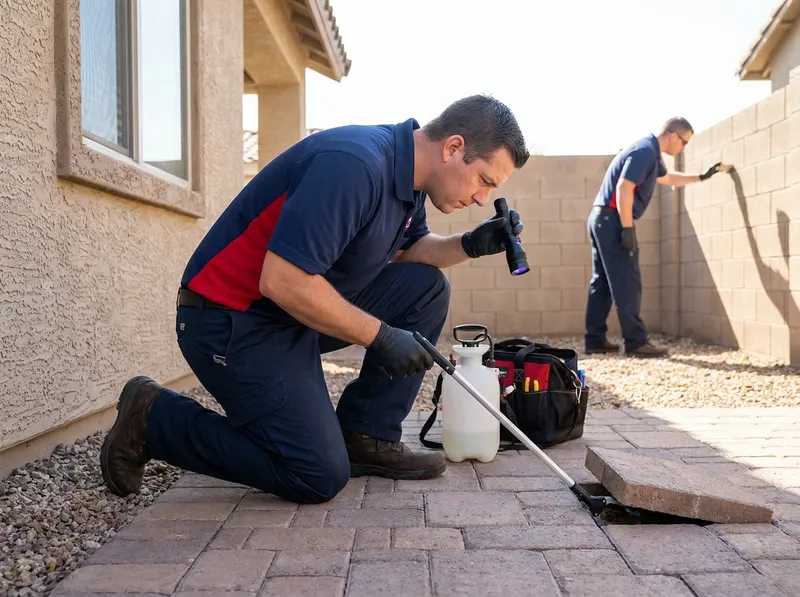
Bark scorpion work in Phoenix is harborage work, not fogging. We inspect the block wall line, weep holes, irrigation valve boxes, pool equipment pads and decorative granite beds, treat void spaces where scorpions actually sit out the day, and use a UV night inspection to confirm where they are traveling. Scorpion pressure is heaviest in Ahwatukee Foothills, Moon Valley and other neighborhoods that back to rocky desert slopes, and it climbs from April through October. Scorpions do not build nests, so success comes from reducing the voids they hide in and the crickets they eat — which is why we look at your gravel depth, wall caps and door sweeps as closely as we look at the inside of the house.
Black widows in Phoenix live low and hidden — under patio furniture, inside meter boxes, in the gap behind block wall caps, along the bottom course of garden walls. We knock down webs, treat those harborage points directly, and treat the ground line where the food supply is. Spider counts follow cricket counts, so a spider problem after a heavy monsoon rain is usually a cricket problem you have not seen yet. Web removal matters more than most people expect: an untouched widow web keeps drawing males and holding egg sacs, so physical knockdown plus treatment beats spraying alone.
German roaches breed indoors, so we bait and treat cracks, hinges, motor housings and voids in the kitchen and baths instead of wetting down floors. American and Turkestan roaches come from outside through sewer clean-outs, irrigation lines and slab penetrations, so those get treated at the source. Older housing stock in Maryvale, Coronado Historic District and Willo Historic District tends to give roaches more entry points because of aged plumbing penetrations and original cabinetry. Expect two to three visits on a real German roach infestation — the first knocks down the adults, the follow-ups catch the nymphs hatching out of egg cases that no product reaches.
Pavement ants, pharaoh ants and fire ants all get treated differently, so we identify the ant before we treat it — spraying the wrong species scatters a colony into three. Ant surges spike after monsoon rain and after landscape watering, which is why Phoenix ant calls cluster in July and August. Treatment covers trailing lines, the slab edge, irrigation emitters, and any planter or tree that is bridging the trail over your barrier. If ants are showing up in a second-floor bathroom or a kitchen island with no visible outdoor trail, the line is usually running inside a wall along a water line, and that gets baited rather than sprayed.
Subterranean termites are the termite Phoenix homes actually get, and they show up as mud tubes on block walls, slab cracks, baseboards and garage corners. Treatment means trenching and treating the soil against the foundation, drilling and treating through slab where tubes come up interior, and treating the specific structural members under attack. Swarms are commonly reported after the first monsoon rains in July and August and again during warm spring stretches. Mud tubes are the tell that separates subterranean activity from drywood evidence — subterranean workers build a soil shelter tube to stay out of the dry air, while drywood damage leaves pellets and no tube at all. Knocking a tube off the wall proves nothing; if the colony is active it is rebuilt within days.
A real estate termite inspection is a documented walk of the structure, block walls, garage, plumbing penetrations and visible slab looking for active tubes, old damage and prior treatment evidence, with a written report for the file. Escrow timelines are tight in the spring and early summer selling season in Phoenix, so booking a week or more ahead is the difference between a clean close and a delay. Ask for the report on state forms and keep a copy for the buyer. Old, treated damage is common in Phoenix homes built on slab and is not automatically a deal problem — what matters to a lender or a buyer's agent is whether the report documents current activity and what was done about it.
Bed bug treatment is room-by-room and evidence-driven: we inspect seams, box springs, headboard brackets, nightstands and baseboard gaps, confirm live activity, then treat harborage directly and re-treat on the egg cycle. Bed bugs do not care about desert heat outdoors, so they hitchhike into Phoenix homes and rentals through luggage, used furniture and tenant turnover rather than the yard. Preparation instructions are given up front, in plain language, before the first visit. Pricing follows room count rather than square footage, because the work is inspection and detail treatment in the rooms people sleep in — a single bedroom caught early costs a fraction of a whole-home job that has spread to a couch and a second bedroom.
Roof rats travel above ground — fence lines, block wall caps, tree limbs, irrigation lines — and enter through roof tile gaps, gable vents and utility penetrations. Control combines trapping to drop the current population with sealing the entry points so the attic does not repopulate. Reports rise in fall and winter as citrus ripens in Arcadia, Encanto-Palmcroft and other older irrigated neighborhoods, so trimming limbs off the roof and picking fallen fruit are part of the fix. Trapping programs run on service intervals rather than a single visit, because rats learn a new object in their runway and need a few days before they commit to it.
Bee swarms in Phoenix are most active February through May, when hives split and relocate into block walls, irrigation boxes, water meter lids and roof voids. An exposed swarm hanging on a tree limb or a patio beam is a different job than an established hive inside a wall void with comb and stored honey, and the price and access work differ accordingly. Do not spray a hive in a wall yourself — abandoned comb and honey left in a void draws ants, roaches and moths and can stain drywall. Call (520) 677-2651 and describe where the bees are entering and how long they have been there.
Recurring exterior service is scheduled maintenance of the barrier around your home: slab edge, block wall line, weep holes, door thresholds, eaves, garage seams, irrigation boxes and the gravel beds where crickets and scorpions stage. Every-other-month service fits lots that back to open desert or a wash; two seasonal visits — one in April or early May before monsoon, one in early fall — fit lower-pressure interior lots and homes with tidy landscaping. Programs are the right tool for landlords and second homes in Desert Ridge, Laveen Village and Ahwatukee Foothills, where nobody is home to notice pressure building until a tenant calls. Ask what the schedule and per-visit cost are before you agree to anything recurring — a program should be a plan you understand, not an open-ended charge.
There are only a few real decisions to make, and the right one depends on what you found and where you found it. If you saw one scorpion in a guest room and nothing since, a single interior-and-exterior treatment with a night inspection is usually the honest starting point. If you are finding scorpions every week — in the tub, on a wall, near the pool deck — a one-time spray is the wrong tool, because bark scorpions live inside block wall voids, under decorative granite, in irrigation boxes and in weep holes, and a single visit only clears what is out foraging that night. In that case a scorpion program with exterior harborage treatment, dust into wall voids and weep holes, and a follow-up cuts the population instead of thinning it. <strong>The trade-off is simple: one visit is cheaper today, a program is what actually changes the count in your home.</strong> If your problem is roaches under the kitchen sink, choose a targeted clean-out with baiting and crack-and-crevice work rather than a general perimeter spray. German roaches breed indoors, so exterior barrier work does almost nothing for them and you will be calling again in five weeks. American and Turkestan roaches coming in from irrigation and sewer lines are the opposite — those are handled outside, at the source, and the interior work is secondary. The trade-off is patience: a bait-driven roach clean-out takes two to three visits over a month to break the egg cycle, while a heavy spray looks dramatic on day one and misses the harborage behind the dishwasher. If you found mud tubes on a block wall, a slab crack, or a baseboard, you need a termite inspection first and a treatment decision second. A localized spot treatment fits an isolated tube on one wall of a detached garage. A full trench-and-treat around the foundation fits an active subterranean colony working a main structure, and that is what most Phoenix homes with repeat activity end up needing. The trade-off is cost against coverage: spot work is a fraction of the price and protects one area, full perimeter work costs more and treats the soil the whole slab sits in. In round numbers, spot work usually runs a few hundred dollars against one wall or one garage corner, while full perimeter trenching on an average single-story Phoenix slab runs four figures and treats every linear foot the structure touches. If you are selling, choose the inspection with a written report on state forms, not a casual look. Real estate termite inspections spike during the spring and early summer selling season, so booking a week or more ahead helps hit escrow deadlines instead of scrambling in the last three days. If you are buying, ask for the report before the inspection period closes so any active tubes get priced while you still have leverage. If the noise is in the attic or you are finding chewed citrus and dark droppings on the block wall, that is roof rats, and the decision is trapping alone versus trapping plus exclusion. Trapping drops the current population. Exclusion — sealing roof tile gaps, gable vents, drain lines and cable penetrations — is what keeps the next family from moving in. The trade-off is that exclusion adds labor and cost up front and saves you from paying for trapping twice. If you rent the property out, choose recurring exterior service on a set schedule so tenants are not calling you mid-lease. Owner-occupied homes with light pressure often do fine with two seasonal treatments — one before monsoon, one in early fall. Heavier-pressure lots against open desert usually need every-other-month exterior work, which is six visits a year instead of two. The trade-off is annual spend versus how often you want to think about it: two visits cost less and leave a gap in August, six visits cost more and keep the barrier fresh through the whole warm season. If what you want is a same-week answer rather than a plan, say so on the phone. A first treatment can usually be scheduled quickly outside the May-through-July rush, and if you are calling in peak heat we will tell you honestly where the next open slot is instead of promising a window we cannot hold. If you want the shortest path to a straight answer, call (520) 677-2651 and describe what you saw, where, and what time of day.
| Free on-site inspection and written ballpark | $0 |
| On-site minimum for any treatment | from $250 |
| Initial interior + exterior treatment, single-family home | $250 – $395 |
| Recurring exterior service, per visit (every other month) | From $250 |
| Two-visit seasonal exterior plan (pre-monsoon + early fall) | $250 – $400 per year |
| Scorpion program initial visit (harborage treatment + void dusting) | $350 – $650 |
| UV night scorpion inspection | From $250 |
| Black widow / spider service with web knockdown | $250 – $375 |
| German roach clean-out (two to three visits) | $350 – $650 |
| Ant treatment, interior trails + exterior slab edge | $250 – $375 |
| Cricket and general crawling insect exterior treatment | $250 – $350 |
| Termite spot treatment, isolated tube or one wall | $400 – $900 |
| Full perimeter trench-and-treat, average single-story slab | $1,200 – $2,800 |
| Real estate termite inspection with written report | From $250 |
| Bed bug treatment, per room | $300 – $550 per room |
| Bed bug treatment, whole home with multiple rooms involved | $900 – $2,200 |
| Roof rat trapping program (multiple service visits) | $350 – $750 |
| Roof rat exclusion and sealing of entry points | $400 – $1,500+ |
| Exposed bee swarm removal | $250–$450 |
| Established hive removal from a wall or roof void | $400 – $1,200+ |
Your exact price is confirmed before any work begins.
Phoenix pest pressure tracks two things almost nobody mentions on a pricing page: how your walls were built and how your street gets its water. Homes on the granite slopes below Camelback Mountain, Piestewa Peak and the South Mountain Park and Preserve boundary in Ahwatukee Foothills sit against natural scorpion habitat, and the standard grouted-block wall with open weep holes gives bark scorpions a shaded, humid void within a foot of the house — which is why treatment there means dusting voids and weep holes, not walking the yard with a hose-end sprayer. <strong>The flood-irrigated older neighborhoods are a different world: Arcadia, Encanto-Palmcroft, Willo Historic District and parts of Coronado Historic District have mature citrus, deep turf and monthly irrigation, and that combination feeds roof rats in fall and winter, drives American and Turkestan roaches up out of sewer clean-outs and valve boxes, and keeps soil moisture high enough that subterranean termites work year-round.</strong> North of Bell Road through Desert Ridge and along the Loop 101, and out in Laveen Village where former farm ground is still being built out, the pattern is newer slabs, fresh landscape gravel and heavy cricket flights after the first monsoon storms — crickets first, then the spiders and scorpions that eat them, usually two to three weeks behind the rain. Sunnyslope and Moon Valley get both problems at once: rocky hillside lots on the upper streets off Cave Creek Road, older irrigated blocks lower down. All of it sits in Maricopa County, where daytime surface temperatures in June and July push pests into the two places that stay cool — the void inside your block wall and the conditioned space inside your house — which is exactly why April and early May treatment beats waiting until something turns up in the bathtub.
Neighborhoods we cover: Arcadia, Ahwatukee Foothills, Willo Historic District, Coronado Historic District, Encanto-Palmcroft, Sunnyslope, Moon Valley, Desert Ridge, Laveen Village, Maryvale.
Pest control in Phoenix starts at a $250 on-site minimum, and most initial interior-plus-exterior treatments on a single-family home land between $250 and $395. Recurring exterior visits typically fall in the $85 to $150 range per visit depending on lot size and pressure. Termite and bed bug work is priced separately because the labor is different. Every figure here is a ballpark — the exact price is confirmed during a free on-site inspection, before any work starts.
Call (520) 677-2651 and you will get a real answer on scheduling on that call, not a callback tomorrow. Outside the May-through-July rush, a first treatment can usually be scheduled quickly; during peak scorpion and monsoon season, routes fill and we will tell you honestly where the next open slot is rather than promise a window we cannot hold. If you found something and want it identified now, text a photo of the insect, the mud tube or the droppings.
Scorpions come back in Phoenix because they live in block wall voids, weep holes, irrigation valve boxes and under decorative granite, and a surface spray only affects what is out foraging that night. Bark scorpions also have a hard cuticle and habitually walk on vertical surfaces rather than through treated dust on the ground. Lasting reduction takes harborage treatment into voids and weep holes, a UV night inspection to map travel routes, and maintenance through the April-to-October active season.
April or early May is the best time to schedule a preventive exterior barrier treatment in Phoenix, before monsoon season arrives and before summer routes fill. Scorpion and spider activity climbs from April through October, with the heaviest call volume during the May, June and July heat. A second visit in early fall covers the post-monsoon cricket and ant surge and the start of roof rat season.
Yes, when the products are applied to the right places and the re-entry instructions are followed. Most of the work on a Phoenix home is exterior and targeted — slab edge, block wall line, weep holes, valve boxes, eaves — rather than broadcast spraying across lawns and pool decks. Interior work is crack-and-crevice and bait placement in voids, not wetting down floors where a dog lies. You will be told exactly what was applied, where, and how long to stay off treated surfaces before the technician leaves.
No. A one-time treatment is a legitimate choice in Phoenix, and it is often the right call for a single sighting or a specific problem like an ant trail or a spider issue on a patio. Recurring service exists because desert pressure rebuilds after every monsoon rain and every irrigation cycle, not because it is required. If a program does make sense for your lot, you should hear the visit schedule and the per-visit price up front and be able to say no.
Look for mud tubes — pencil-width lines of soil running up a block wall, out of a slab crack, along a garage corner or behind a baseboard. Subterranean termites are the termite Phoenix homes get, and they build those tubes to stay out of dry desert air. Discarded wings on a windowsill after a July or August monsoon storm are another sign, since swarms are commonly reported after the first heavy rains and during warm spring stretches. If you find a tube, photograph it and leave it in place so an inspector can judge whether it is active.